Why the pattern of interruption may matter more than total time sitting.
The research behind EPX3, with sources and limits. Observational studies show links, not proof of cause.
The Framework
What is Digital Sedentary Syndrome?
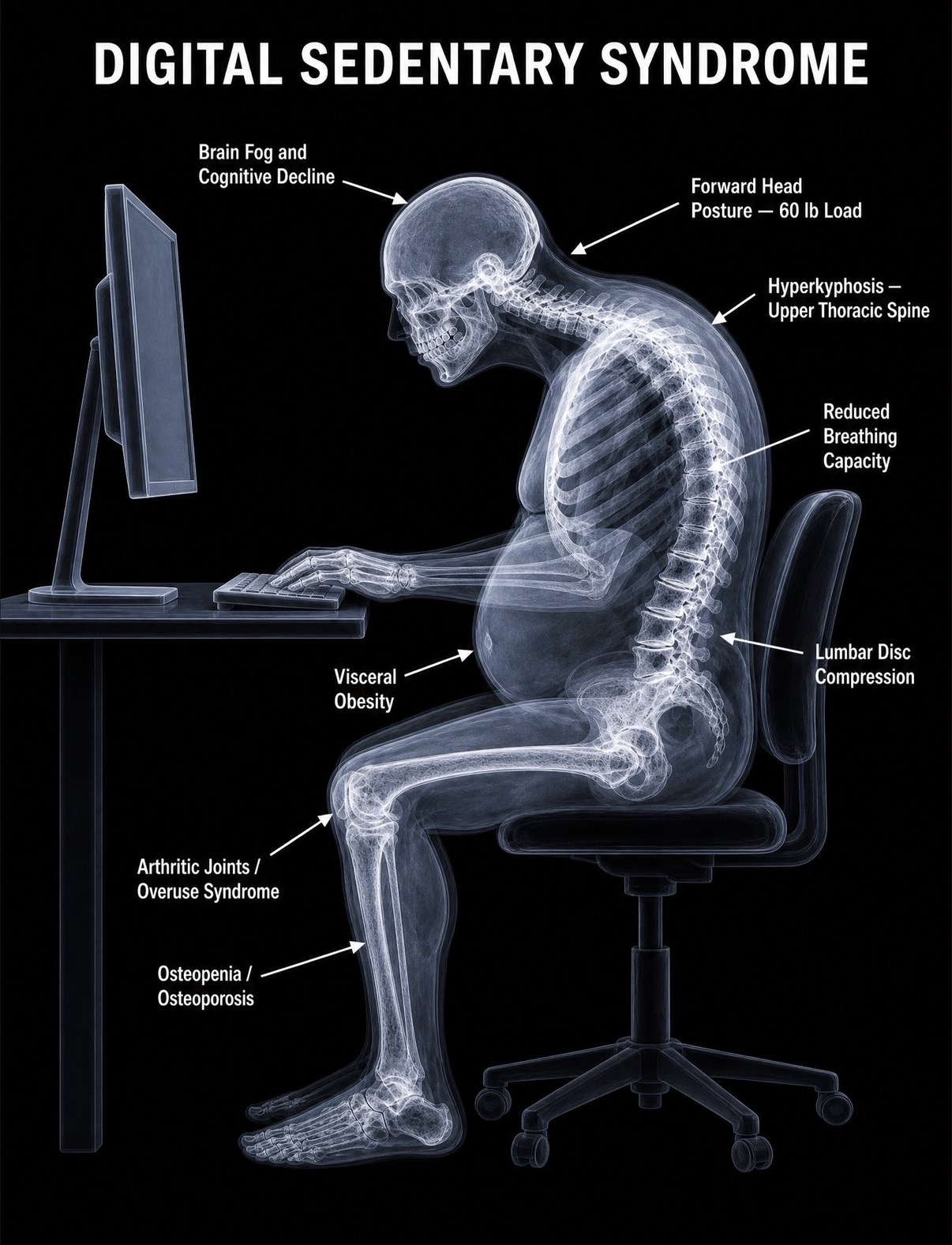
Digital Sedentary Syndrome (DSS) is a proposed framework describing the cluster of problems that develops when prolonged, screen-based sitting work is combined with poor sleep, chronic stress and low movement: neck and back pain, fatigue, disrupted sleep and declining focus.
DSS is a proposed clinical framework developed by Dr. Michael Majette. It is not an established medical diagnosis, and it is not recognized in the ICD or DSM. Its components are individually well documented; the framework and the EPX3 program built on it are being tested.
An illustration of the problems the DSS framework proposes are linked to years of prolonged screen-based sitting. It is an artistic rendering, not a medical image or a real patient. Each label is an association described in the research, not a diagnosis, and the “60 lb” figure is a biomechanical model estimate for a steep forward head tilt. See the studies and their limits.
How EPX3 responds
A licensed physician screens your people with health questionnaires and a clinical review, leads weekly accountability and one-on-one coaching, provides care within the scope of his Florida license, refers out what falls outside it (including imaging and radiology), and re-measures at 13 weeks.
What your company sees
Anonymous group results only: how your own workforce changed against your own baseline. Individual health information stays with the individual and their physician.
What we do not claim
We do not promise a return multiple, a diagnosis, or lower insurance premiums. We promise measurement. Where a number comes from a study, we name the study and its limits.
Why measurement is the point
Across the major reviews and trials we examined, most call for more or better-designed research, and about half call for better outcome measurement. None calls for new technology. The best-run wellness trials found no savings. The gap is trustworthy outcomes data, so that is what EPX3 is built to collect.
The Numbers
What the evidence actually shows
Read The Research → Every study behind the program, with each study's limits stated up front.
Serve in the military, fire, EMS or law enforcement? See EPX3 Tactical.
78
outcomes checked in a big randomized wellness trial (BJ's Wholesale Clubs). Exercise and weight care improved. Health costs, missed work and job performance did not.
18%
lower cancer-death risk linked to each extra hour of sitting broken up by movement (UK Biobank, 91,292 adults; a link, not proof)
5 min
walk, once an hour. A two-week trial of 11,484 people judged it the best balance of benefit and ease (self-reported)
0%
pain reduction from sit-stand desks alone in a 12-month randomized trial
The Problem
Nobody's pricing this correctly
Most workplace wellness spend goes toward tools the largest trials have already tested — and found with no meaningful effect.
Sit-stand desks
Standing desks alone did not reduce back or neck pain in a 12-month randomized trial, even though they cut sitting time. Interrupting sitting is the habit to build.
Lumbar cushions
Static lumbar support failed Cochrane review entirely — no meaningful benefit found.
Blue-light glasses
No measurable effect across 17 clinical trials, despite being one of the most-purchased "eye strain" products.
Where Do You Land?
Your chair may be doing to you what the truck seat does to a driver.
Long-haul truck drivers are the most studied people who sit for a living. Many office workers sit almost as long. "Desk driver" is a plain-English comparison, not a diagnosis. Slide the dials below to see where research would place a person like you, and what two different paths could look like.
First, the truck seat
69%
of long-haul drivers were obese
vs 31% of US working adults
14%
had diabetes
vs 7% of US working adults
51%
smoked
vs 19% of US working adults
88% of drivers had at least one of three risk factors: high blood pressure, smoking or obesity. For US workers it was 54%. Driver risk comes from the whole package, not the seat alone. Office workers share the sitting part.
Source: NIOSH survey of 1,670 long-haul drivers at 32 truck stops, 2010 (Sieber et al., American Journal of Industrial Medicine, 2014). In 1953, Dr. Jeremy Morris reported that London bus drivers had more heart disease than the conductors who climbed stairs all day (The Lancet).
Where do you land?
A general, educational picture based on large studies of groups of people. It is not a diagnosis and not a forecast for any one person. Nothing you move here is saved or sent.
Two possible paths
Same person, same job. These are illustrations of the direction studies point, not predictions.
Today, age 45
Same routine, age 65
With daily movement, age 65
Illustrations only. This page collects no photos and stores nothing.
Two big studies on sitting, one about desk jobs
Both are large, published in respected journals, and followed real people for years. Both show a link, not proof of cause.
Sitting at work · JAMA Network Open, 2024
+34%
higher risk of dying from heart disease for people who mostly sat at work, compared with people who did not. Overall death risk was 16% higher.
People who mixed sitting with moving at work had no extra risk. And 15 to 30 more minutes of activity a day was linked to cancelling the extra risk.
481,688 adults followed about 13 years (Gao et al.). Results adjusted for age, sex, education, smoking, drinking and body weight.
The 10.6-hour line · JACC, 2024
10.6hours
of sitting a day was the point where heart failure and heart-death risk started to climb. Below it, the added risk was small.
Exercise (150 minutes a week) substantially reduced the extra heart attack and irregular heartbeat risk linked to sitting. It did not remove the higher risk of heart failure and heart death.
89,530 UK adults, average age 62, wore a wrist tracker for 7 days and were followed about 8 years. These were adults in general, not truck drivers.
What studies link to long, unbroken sitting
People who sat the most compared with people who sat the least, pooled across many studies. It is a link, not proof of cause.
Source: Biswas et al., Annals of Internal Medicine, 2015 (hazard ratios 1.91, 1.24, 1.18, 1.17, 1.14). That review found activity lowered these risks but did not erase them. A separate analysis of over 1 million people (Ekelund et al., The Lancet, 2016) found that about 60 to 75 minutes of moderate activity a day removed the extra risk linked to sitting 8 or more hours. Researchers still debate how much activity fully offsets sitting, so we say: movement helps a lot. Every study is listed with its limits on The Research.
The easiest first step
In a real-world trial of 11,484 people (the Body Electric Challenge, British Journal of Sports Medicine), a five-minute walk every 30, 60 or 120 minutes left people less tired and in a better mood for two weeks, and work performance did not suffer. Hourly walks were judged the best balance of benefit and ease. Results were self-reported.
"I lost my father at 56. I have watched families go through heart surgery and stroke recovery after years at a desk. EPX3 exists so more people get a wake-up call that is a warning, not an emergency."
Dr. Michael Majette, founder of EPX3
Why It Compounds
The load you can't see
Chronic conditions rarely arrive suddenly. They are the late bill for years of small, repeated strains: long sitting, short sleep, constant demands, food that is easy but not good. Researchers call the running total allostatic load, the wear and tear from a stress system that never gets to switch off.
Each link in this loop has support from controlled studies. No single study has followed one person around the full circle, so treat the loop as a well-supported model, not a proven cycle.
76%
of US adults have at least one chronic condition, and over half have two or more (CDC, 2023)
+385
calories a day eaten after short sleep, with no change in energy burned (meta-analysis of sleep-restriction experiments)
+33%
higher stroke risk for people working 55+ hours a week compared with 35 to 40 (pooled data on more than 500,000 people)
60 to 75
minutes of daily moderate activity: the level at which heavy sitters showed no meaningful excess risk of early death in a pooled analysis of 1 million people
Break the loop at the easiest link
The same load that drives the spiral also drains the willpower needed to climb out of it. So the evidence favors small daily doses anchored to routines you already have, the way brushing your teeth works, over big resolutions.
Protect sleep
Risk of early death is lowest near 7 hours of sleep in large observational studies. Evening screens delayed sleep and suppressed melatonin in a small lab study.
Interrupt the chair
The WHO recommends 150 to 300 minutes of moderate activity a week plus strength work, and advises limiting sedentary time.
Keep some margin
Control over your time and demands, not just hard work, is what the job-strain research ties to lower cardiovascular risk. Small, planned if-then routines make habits stick.
Why a desk upgrade is not a program
Most workplace spending goes to equipment. The trials show that equipment alone helps for a while and then fades, and that pooled results rank programs combining several elements ahead of equipment alone.
72%
of working hours spent sedentary by office workers, the highest of any occupational group (132 device-measured studies, 15,619 workers)
29%
of workers still active at 10 p.m. were back in their inboxes (Microsoft 365 usage data, 2025; a vendor’s own measure, not a clinical one)
100 to 57
minutes less sitting per workday from sit-stand desks: about 100 in the first three months, about 57 by three to twelve months (Cochrane review of 34 workplace trials, low-certainty evidence)
52
minutes less sitting per 8-hour day from programs combining several elements (11 randomized trials, moderate-certainty evidence)
Sources: CDC, About Chronic Diseases, 2026 (BRFSS 2023). Al Khatib et al., European Journal of Clinical Nutrition, 2017. Kivimäki et al., The Lancet, 2015. Ekelund et al., The Lancet, 2016. Yin et al., Journal of the American Heart Association, 2017. Chang et al., PNAS, 2015. Bull et al., British Journal of Sports Medicine, 2020. Kivimäki et al., The Lancet, 2012. Gollwitzer and Sheeran, 2006. Prince et al., International Journal of Behavioral Nutrition and Physical Activity, 2019. Microsoft, Work Trend Index special report, June 2025. Shrestha et al., Cochrane Database of Systematic Reviews, 2018. Zhou et al., JMIR Public Health and Surveillance, 2023. Zhou, Trost, Ryde et al., PLOS Medicine, 2026 (UK Biobank, sitting and cancer). Body Electric Challenge, British Journal of Sports Medicine (11,484 participants; self-reported). Song and Baicker, JAMA, 2019 (BJ’s Wholesale Clubs trial). These are associations from observational studies and short experiments. They describe populations, not individuals, and are not a diagnosis, a treatment claim, or a promise of any result.
What Actually Moves The Needle
It's not how long. It's how it's broken up.
A UK Biobank study followed 91,292 adults for about 12 years. Each extra hour of sitting that was broken up by movement was linked to about 18% lower risk of dying from cancer. That is a link, not proof of cause. In a real-world trial of 11,484 people (the Body Electric Challenge, British Journal of Sports Medicine), a five-minute walk every 30, 60 or 120 minutes left people less tired and in a better mood for two weeks, and work performance did not suffer. Hourly walks were judged the best balance of benefit and practicality. Results were self-reported.
Five minutes, once an hour: a small, practical dose.
The Assessment or The Session
An anonymous exposure survey, a workstation audit, and a review of what you already run — ending in actionable redesign recommendations.
The Curriculum License
Seven learning modules, mandatory manager training, an environmental-redesign workbook, and an automated accountability system. 12-month system.
The Leadership Session
A half-day session with your executive team — the honest limits of what any program can promise, and why compliance actually matters. Sold with the License.
Accountability & Coaching
Monthly group coaching and habit-tracking — the "someone's actually checking" piece that keeps the compliance rate high. Ongoing.
Certification
An annual credential, earned only through a completion-rate minimum and a re-run of the Assessment showing measurable improvement. Year-one renewal.
Our Mantra
Marginal gains: small improvements that compound into results
Sir David Brailsford's marginal gains philosophy starts from one idea: break performance into every part, improve each part by a small amount, and the combined effect becomes large. He applied it to British Cycling and later Team Sky, relying on many small, consistent changes rather than one dramatic overhaul.
Small, consistent changes that compound.
Equipment
Seat comfort, tire grip, and aerodynamic fabrics, each tested rather than assumed.
Recovery
Heated overshorts to keep muscles warm, biofeedback to tune training, and better sleep equipment.
Attention to Detail
Hand hygiene, travel routines, and small visual cues, such as white team trucks that made dust easy to spot.
The approach is credited with multiple Olympic gold medals and Tour de France wins.
What we take from it
Process over outcome. Daily routines and habits drive results.
Continuous improvement. Every change counts, however small.
Experiment. Test new tools and methods before deciding what works.
Mental preparation. Readiness, visualization, and mindfulness are part of performance.
We apply the same logic to employee performance. Sleep, movement, stress, and recovery each get a small, measured improvement, and the combined effect is what we are betting on for engagement and retention.
Inspired by Sir David Brailsford’s “marginal gains” philosophy—where continuous, incremental improvements yield extraordinary performance—we pair clinical excellence with Unreasonable Hospitality. We partner with organizations to create a healthcare experience rooted in trust, empathy, and active listening. By making employees feel truly supported and valued, we drive meaningful engagement that yields sustainable, life-changing improvements in workforce health, productivity, and overall well-being.
Our mantra, in conjunction with Unreasonable Hospitality: small, deliberate improvements, repeated daily, build extraordinary results.
“Nothing in this world can take the place of persistence.”
Widely attributed to Calvin Coolidge, but no primary source has been confirmed.
Go deeper
The full research library.
The complete sources, with sample sizes and limits, are on the Research page and in the free book.